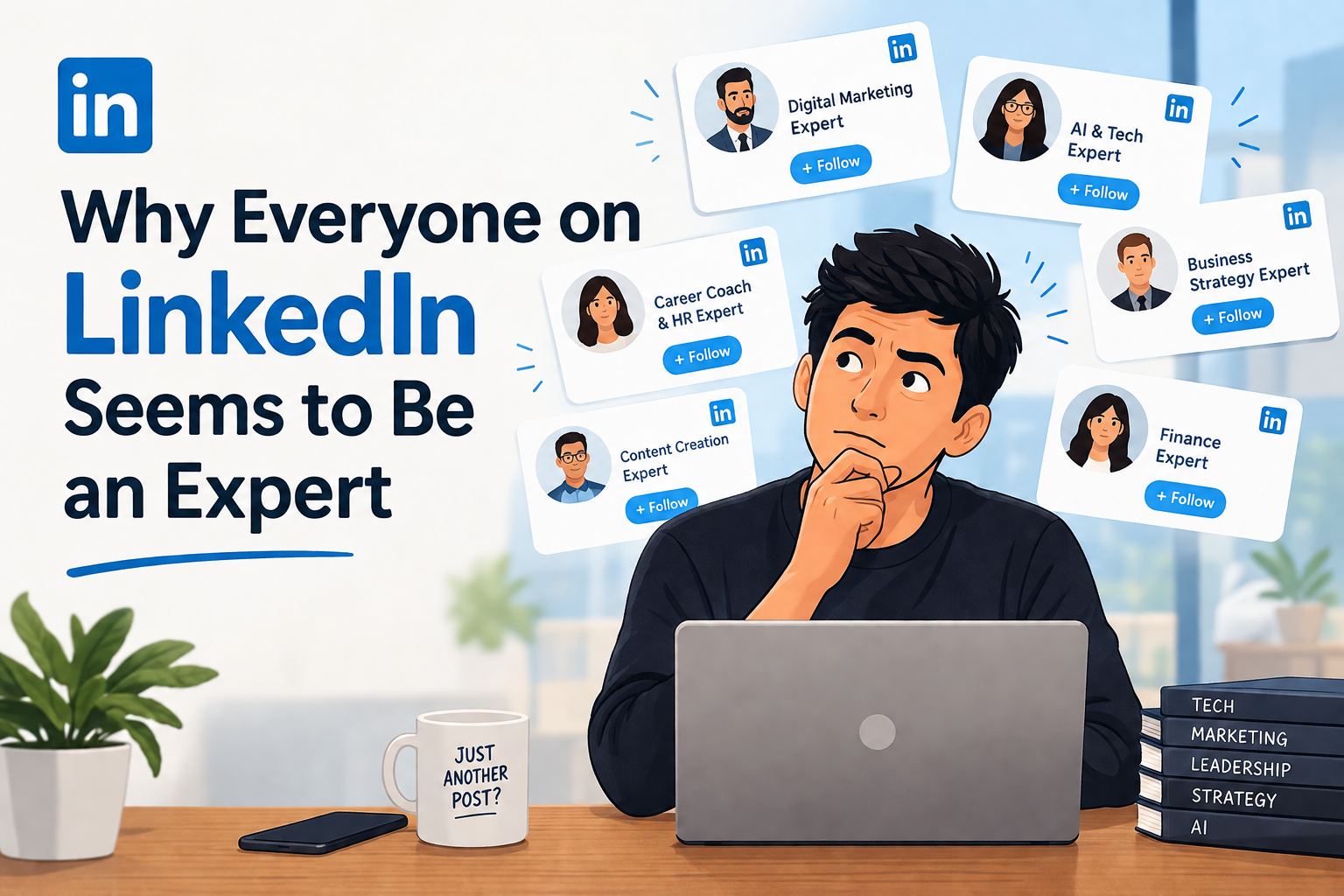
Open LinkedIn for five minutes and you'll probably notice something strange.
Everyone seems to be an expert.
Someone has the perfect morning routine.
Someone has the ultimate productivity system.
Someone has decoded leadership.
Someone has the secret to becoming successful.
Someone has discovered the one thing every entrepreneur needs to know.
And, of course, someone has turned their latest coffee order into a lesson about business.
LinkedIn was originally built around professional networking, careers, jobs, and business relationships. But over the years, it has evolved into something much bigger.
It has become a place where people don't just show what they do.
They show what they know.
And sometimes, they show that they know a little too much about everything.
The "Expert" Effect
There's nothing wrong with expertise.
In fact, expertise is exactly what makes LinkedIn valuable.
The problem begins when having an opinion starts looking the same as having expertise.
Today, it's incredibly easy to build the appearance of authority.
You can read a few articles, watch some videos, use AI to summarize an industry report, and write a confident post about a subject you've barely explored.
Add a professional photograph, a few business buzzwords, and a headline containing words like:
Founder | Entrepreneur | Visionary | Strategist | Thought Leader
…and suddenly, you look like an authority.
The internet has made knowledge easier to access.
But LinkedIn has made the appearance of knowledge easier to manufacture.
Confidence Is Often Mistaken for Competence
One of the most interesting things about LinkedIn is how confidently people communicate.
Statements rarely sound uncertain.
Instead of:
"I think this might work."
we often see:
"Here's what I've learned about success."
Instead of:
"This is one approach you could try."
we see:
"This is exactly how you should build your career."
The difference is subtle, but important.
Confidence makes content easier to consume.
People don't necessarily want complicated answers. They want clarity.
And the person who confidently says, "Here are the five rules of success," often gets more attention than the person who says, "It depends."
But real expertise often involves saying:
"It depends."
Because experienced people understand that most real-world problems aren't simple.
Real Experts Usually Know How Much They Don't Know
There's an interesting paradox about expertise.
The more you learn about a subject, the more you understand its complexity.
A beginner might think:
"I understand how this works."
Someone with years of experience might think:
"There are several ways this can go wrong."
Experience doesn't always make you more confident.
Sometimes, it makes you more cautious.
A senior developer knows that a seemingly simple software change can create unexpected problems.
An experienced manager knows that managing people isn't about following five simple rules.
A seasoned entrepreneur knows that success isn't simply the result of waking up at 5 AM and working harder.
A good investor knows that even a well-researched decision can fail.
Experience teaches you that reality is messy.
Social media, however, rewards simplicity.
And that's where the problem begins.
LinkedIn Rewards Certainty
Think about what makes a post attractive.
"Here are 7 things you need to do to succeed."
That's clickable.
"Success is complicated, and different approaches work for different people depending on their circumstances."
That's accurate.
But it doesn't have the same punch.
Social platforms reward content that is:
- Easy to understand
- Easy to agree with
- Easy to share
- Emotionally engaging
- Presented with confidence
As a result, nuanced ideas often lose against simple formulas.
"Work hard."
"Wake up early."
"Network."
"Read every day."
"Never give up."
None of these ideas are necessarily wrong.
The problem is that they're incomplete.
And incomplete advice presented as universal truth can become misleading.
In a world where everyone wants to look like an expert, knowing what you don’t know is a rare skill.
The LinkedIn Storytelling Formula
There's another reason everyone seems like an expert.
LinkedIn has developed its own storytelling language.
You may have seen posts like:
"Three years ago, I had nothing."
"Today, I run a successful company."
"Here are the five lessons I learned."
The story usually follows a predictable structure:
Struggle → Breakthrough → Lesson → Advice
There's nothing inherently wrong with this format.
Stories are powerful ways to communicate.
But when every experience gets converted into a universal lesson, something gets lost.
A person loses a job.
Lesson: "Never depend on one income."
Someone gets promoted.
Lesson: "Always believe in yourself."
Someone starts a company.
Lesson: "Take risks."
Someone fails.
Lesson: "Failure is the best teacher."
Eventually, every event becomes evidence for a predetermined philosophy.
And that's when LinkedIn can start feeling less like a professional network and more like a never-ending collection of motivational speeches.
The Problem With Turning Every Experience Into Advice
Experience is valuable.
But experience isn't automatically expertise.
If someone successfully built one company, that doesn't necessarily mean they understand every business.
If someone got a job through networking, that doesn't mean networking is the secret to everyone's career.
If someone became successful without a degree, that doesn't mean education is useless.
If someone wakes up at 4:30 AM and is productive, that doesn't mean everyone else should do the same.
A personal experience can tell us:
"This worked for me."
It doesn't automatically prove:
"This will work for everyone."
That's an important distinction.
The Rise of "Thought Leadership"
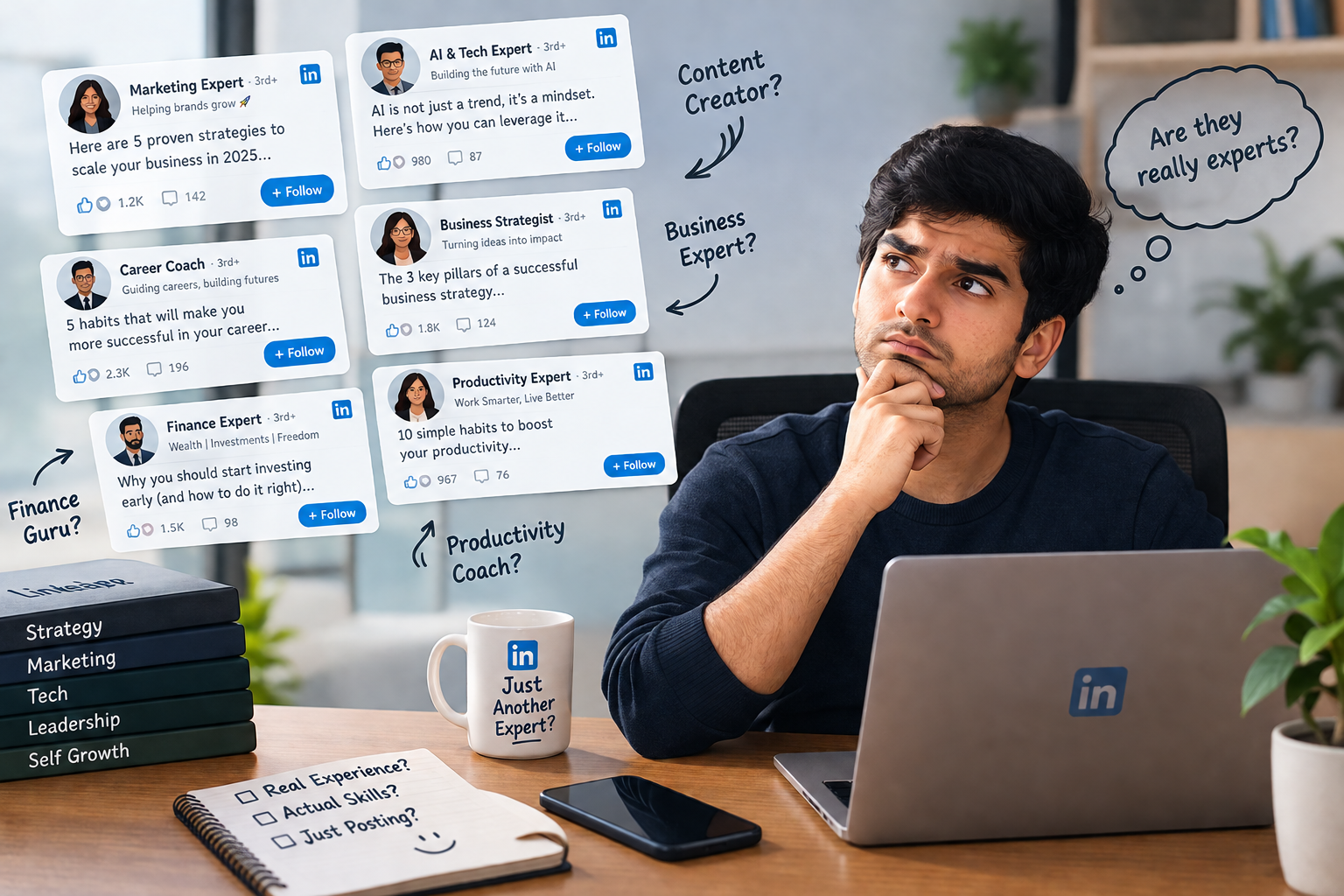
LinkedIn has also created a strong incentive to become a "thought leader."
But what exactly does that mean?
Sometimes, it simply means having something to say consistently.
And that's not necessarily bad.
Sharing ideas can help people discover you.
Writing can help you organize your thinking.
Teaching can strengthen your understanding.
Building a personal brand can create professional opportunities.
But there is a danger when personal branding becomes more important than actual expertise.
You can spend hours learning how to look knowledgeable instead of spending hours becoming knowledgeable.
You can optimize your posts while neglecting your craft.
You can become very good at talking about doing something without actually doing it.
And social media makes that distinction surprisingly difficult to see.
AI Makes This Even More Interesting
Artificial intelligence has made the situation even more complicated.
Today, anyone can ask an AI tool to:
- Explain a complex topic
- Summarize research
- Generate an opinion
- Write a professional post
- Create a list of "10 lessons"
- Turn an ordinary experience into a motivational story
This is incredibly useful.
But it also creates a new problem.
The ability to communicate information is no longer strong evidence that someone deeply understands it.
Someone can produce a polished explanation without having years of experience behind it.
That doesn't mean AI-generated content is bad.
It means we need to become better at distinguishing between:
information, experience, understanding, and expertise.
They are not the same thing.
So, How Do You Recognize a Real Expert?
There isn't a perfect formula.
But there are some signals worth looking for.
1. They Explain the "Why"
A superficial expert tells you what to do.
A knowledgeable person can explain why it works.
And a real expert can usually explain when it doesn't work.
2. They Talk About Failure
If someone has supposedly mastered everything but never talks about mistakes, limitations, or failures, be skeptical.
Real experience comes with scars.
3. They Understand Trade-offs
Most professional decisions involve compromises.
Speed vs quality.
Cost vs performance.
Risk vs reward.
Short-term results vs long-term growth.
Experts understand that choosing one thing often means giving up another.
4. They Can Say "I Don't Know"
This may be one of the strongest signs of genuine expertise.
Someone who has spent years in a field knows that there are questions they can't answer.
And they're comfortable admitting it.
5. They Don't Need to Turn Everything Into a Rule
Good advice often contains context.
Instead of saying:
"Always do X."
an experienced person might say:
"X worked in this situation because of these conditions."
That distinction matters.
Confidence can make an opinion sound like expertise, but time and experience are what make it valuable.
Maybe We Should Stop Trying to Be Experts
There's a strange pressure on professional social media to always appear knowledgeable.
You have to have an opinion.
You have to post regularly.
You have to build a personal brand.
You have to teach.
You have to inspire.
You have to demonstrate expertise.
But what if we approached LinkedIn differently?
What if instead of pretending to have all the answers, we shared better questions?
Instead of:
"Here are the 5 rules every developer must follow."
we could say:
"Here's something I struggled with as a developer and what helped me."
Instead of:
"This is how you become successful."
we could say:
"This is what worked for me, and here's where it might not work for someone else."
Instead of presenting ourselves as gurus, we could simply present ourselves as people who are learning.
That might actually make LinkedIn more valuable.
The Best LinkedIn Content Doesn't Always Come From Experts
Sometimes the most valuable post comes from someone who is still figuring things out.
A junior developer explaining a bug they finally solved.
A manager sharing something they got wrong.
A founder discussing a failed experiment.
A student documenting what they're learning.
A professional asking a genuinely interesting question.
These posts don't necessarily say:
"I have the answer."
They say:
"Here's what I discovered."
And there's a huge difference.
The first one demands authority.
The second one invites conversation.
Expertise Should Be Earned, Not Performed
Perhaps that's the bigger lesson.
LinkedIn isn't the problem.
Personal branding isn't the problem.
Sharing knowledge isn't the problem.
Even motivational posts aren't the problem.
The problem is when presentation becomes a substitute for substance.
A polished profile doesn't make someone an expert.
Thousands of followers don't automatically make someone an expert.
A viral post doesn't make someone an expert.
And confidently written advice certainly doesn't make someone an expert.
Expertise comes from something much less glamorous:
Time.
Practice.
Failure.
Curiosity.
Deep work.
Experience.
Learning.
And the willingness to change your mind when reality proves you wrong.
Maybe that's the kind of expertise worth following.
Not the person who always has the perfect answer.
But the person who has done the work, understands the complexity, admits what they don't know, and is still willing to learn.
Because in a platform where everyone seems to be an expert,
sometimes the most credible person in the room is the one who simply says:
"Here's what I know. Here's what I don't know. And here's what I'm still learning."

0 Comments