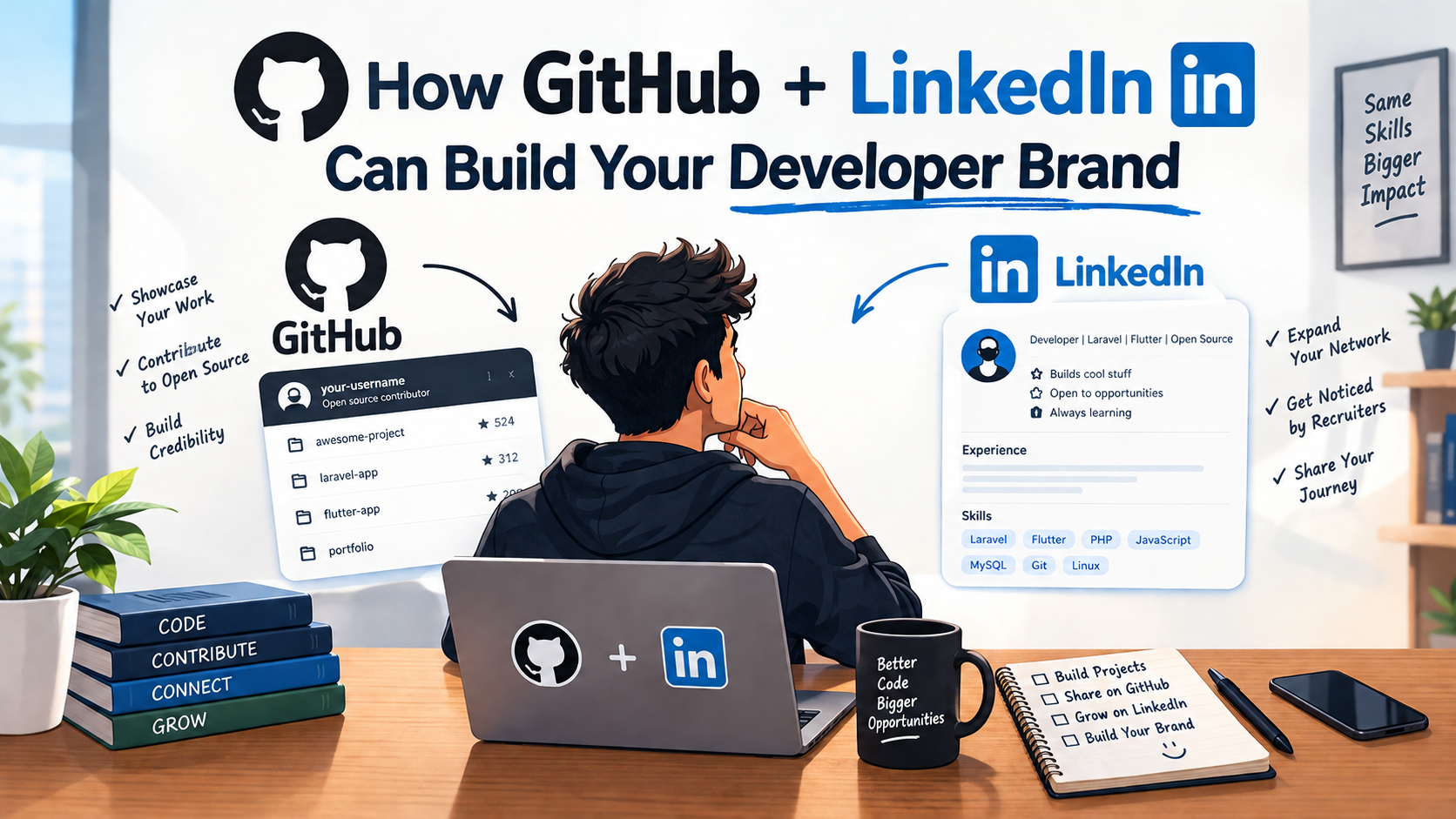
For developers, building a personal brand can feel unnecessary.
You might think:
"I'm a developer. My code should speak for itself."
And technically, you're right.
But here's the problem:
Your code can speak, but people need a reason to find it first.
That's where GitHub and LinkedIn can work together.
GitHub can show what you can build.
LinkedIn can show how you think, what you're learning, and what you know.
Together, they create something much more powerful than either platform alone: a public record of your professional journey.
Your Resume Says What You Did. Your GitHub Shows It.
A resume can say:
"Built a full-stack web application using Laravel and MySQL."
That's useful.
But a recruiter or developer can only take your word for it.
Now imagine they click your GitHub and find:
- The actual project
- Clean source code
- Meaningful commits
- A useful README
- Screenshots
- Documentation
- Technologies used
- Problems you solved
Suddenly, the statement on your resume has evidence behind it.
That's the real advantage of GitHub.
It turns claims into proof.
You don't have to tell everyone that you're a developer.
You can show them.
GitHub Is Your Developer Portfolio
Think of GitHub as more than a place to store code.
It's your technical portfolio.
A good GitHub profile can answer questions that a traditional resume can't:
What have you built?
How do you structure your projects?
Do you document your work?
Can you work with other technologies?
Do you understand version control?
Do you finish projects?
How do you approach problems?
Of course, nobody expects your GitHub to be perfect.
In fact, it shouldn't necessarily look like a collection of flawless projects.
Your GitHub should show progress.
A repository from two years ago might look very different from something you build today.
That's okay.
That's evidence that you're learning.
But GitHub Alone Has a Problem
Here's where LinkedIn comes in.
You could build an amazing project and put it on GitHub.
But how many people will actually discover it?
Probably not many.
GitHub is excellent at showcasing technical work, but it isn't primarily designed for professional storytelling.
LinkedIn fills that gap.
Think of the two platforms this way:
GitHub = Proof
LinkedIn = Distribution
GitHub holds the work.
LinkedIn helps people discover the work.
LinkedIn Gives Your Projects a Story
Imagine you've just built a web application.
You could simply post:
"Built a Laravel application. Check it out on GitHub."
That's fine.
But you could tell a story instead.
For example:
"I wanted to understand how authentication works beyond simply using a package, so I built a small Laravel application from scratch."
Then explain:
- What you were trying to learn
- What problems you encountered
- What you changed
- What surprised you
- What you learned
- What you would improve next
Then share the GitHub repository.
Now you're not simply promoting a project.
You're documenting your learning process.
And that's much more interesting.
Don't Just Share What You Built. Share What You Learned.
This is one of the biggest mistakes developers make on LinkedIn.
They post:
"I built X."
And stop there.
But the interesting part isn't always what you built.
It's why you built it and what happened while building it.
Maybe you spent three hours debugging a database issue.
Maybe your API initially returned terrible response times.
Maybe you struggled with authentication.
Maybe you learned something about caching.
Maybe you completely changed your architecture halfway through.
Those experiences are content.
Your mistakes are content.
Your debugging sessions are content.
Your discoveries are content.
Your development journey is content.
A Simple GitHub → LinkedIn Content Strategy
You don't need to become a full-time content creator.
You can simply turn the work you're already doing into content.
For every meaningful project, consider creating several LinkedIn posts.
Post 1: The Beginning
Talk about the problem you're trying to solve.
"I've started building a small application to better understand REST APIs."
This creates context.
Post 2: The Challenge
Talk about something that went wrong.
"I spent most of yesterday debugging an issue that turned out to be one missing configuration."
Developers can relate to this.
Post 3: The Lesson
Explain something you learned.
"One thing this project taught me about database indexing..."
Now you're providing value.
Post 4: The Finished Project
Show the final result.
Include:
- Screenshot
- Short explanation
- Tech stack
- GitHub link
- What you learned
Post 5: The Reflection
A few weeks later, talk about what you would do differently.
This is often more valuable than announcing the project itself.
Your GitHub README Matters More Than You Think
One of the easiest ways to improve your developer brand is to improve your project documentation.
A repository shouldn't feel like:
"Here's some code. Good luck."
A good README should quickly explain:
What is this?
Describe the project in a few sentences.
Why did you build it?
Explain the problem or learning objective.
What technologies did you use?
For example:
- Laravel
- PHP
- MySQL
- JavaScript
- Vue
- Docker
How do I run it?
Provide installation and setup instructions.
What does it look like?
Add screenshots or a demo.
What did you learn?
This is particularly useful for personal projects.
It gives visitors insight into your thinking.
Your GitHub Profile Should Tell a Story
You don't need 100 repositories.
You need a few good ones.
Imagine someone visits your profile and sees 50 unfinished repositories.
That's not necessarily impressive.
Now imagine they see five projects:
- A full-stack application
- An API project
- A meaningful frontend project
- An automation/tool project
- A project you're currently improving
Each has:
- Good documentation
- Clean structure
- Useful commits
- Screenshots
- Clear descriptions
That's much stronger.
Quality tells a better story than quantity.
Your LinkedIn Profile Should Connect the Dots
Your LinkedIn profile should make it easy for someone to understand what you do.
Your headline shouldn't just say:
"Software Developer"
It can communicate more.
For example:
Full Stack Developer | Laravel & JavaScript | Building Web Applications | Exploring AI & Automation
Your About section can explain:
- What you build
- What technologies you work with
- What you're currently learning
- What kind of problems interest you
And your Featured section can point people toward your best work.
That's where GitHub becomes especially useful.
 Your LinkedIn Profile Should Connect the Dots">
Make Your Two Profiles Work Together
The goal isn't to duplicate everything.
Instead, make them complement each other.
"Here's what I learned."
GitHub
"Here's what I built."
"Here's the problem I faced."
GitHub
"Here's how I solved it."
"Here's what I'd do differently."
GitHub
"Here's the implementation."
This creates a loop between your professional story and your technical evidence.
You Don't Need to Go Viral
This is important.
Building a developer brand isn't about getting 100,000 views.
You don't need viral posts.
You don't need thousands of followers.
You don't need to post motivational quotes every morning.
You need the right people to notice your work.
Imagine a recruiter sees your LinkedIn post.
They find it interesting.
They visit your profile.
They see your GitHub.
They open a project.
They read your README.
They see that you understand the technology.
That entire journey can happen because you shared one useful post.
That's more valuable than chasing vanity metrics.
Consistency Beats Perfection
You don't need to publish every day.
You don't even need to publish every week.
Instead, create a simple habit.
For example:
Build → Document → Share → Improve
Build something.
Document what you learned.
Share an insight.
Improve the project.
Repeat.
After six months, you won't just have a collection of LinkedIn posts.
You'll have a public history of your development.
And you'll have a GitHub profile that demonstrates your technical growth.
Your Developer Brand Is Being Built Anyway
Whether you intentionally build a personal brand or not, people will eventually form an impression of your professional identity.
The question is:
Will you control the story?
Your GitHub can show that you build.
Your LinkedIn can show that you communicate.
Your projects can show that you solve problems.
Your posts can show that you think.
Your failures can show that you learn.
And together, they create something a resume alone can't provide.
The Real Advantage
The biggest advantage of GitHub + LinkedIn isn't simply getting more followers or making your profile look impressive.
It's that you're creating public proof of your growth.
Six months from now, someone can look at your work and see what you were learning.
A year from now, they can see how your projects evolved.
A recruiter can see more than a list of technologies.
Another developer can learn from something you struggled with.
And you can look back and realize just how much you've improved.
That's what a developer brand should ultimately be.
Not a carefully manufactured image of expertise.
But a visible trail of curiosity, work, learning, and growth.
GitHub shows what you can build.
LinkedIn shows how you think.
Together, they show who you're becoming as a developer.
And that's a much stronger story than simply saying:
"I'm a developer."

0 Comments